You've heard about P-DTR from someone who came out of therapy with a strange story. Their shoulder hurt, and the therapist worked on their ankle. Or a muscle that gave way in a test held after a simple touch. And you wonder if it's something serious or one of those “magic things” you stay away from.
What P-DTR is, in short: a neurological therapy that works directly with the central nervous system. The therapist tests the muscles, looks for the places the body is still protecting after old accidents, treats them with small stimuli, a touch or a light press, then tests again, on the spot, the muscle that was giving way.
Below I explain where the name comes from, what happens in the body after an accident and how a session goes at my clinic. Plus why I work it alongside kinetotherapy and what studies show about the way the body protects itself after an accident.
What is P-DTR and where does it come from?
P-DTR is a neurological therapy that works directly with the central nervous system, developed by Prof. Dr. Jose Palomar, an orthopaedic surgeon. The P-DTR school, based in Switzerland, runs courses in the United States, Mexico and Europe, and there are more than 5,000 P-DTR therapists in the world.
I did the full course, 2 years and 6 modules, I've been practising P-DTR for 2 years, and in 2025 alone I did 260 P-DTR therapy sessions. I got here after being a patient myself, with an L4-L5 disc herniation of 10 millimetres.
Maybe you picture P-DTR as a gentler massage or as a manipulation. On the table nothing gets rubbed and nothing gets cracked: a muscle is tested, a spot is worked on, the muscle is retested.
What does the name Proprioceptive Deep Tendon Reflex mean?
The name P-DTR comes from English, from Proprioceptive Deep Tendon Reflex, and it says what P-DTR is: a therapy built on proprioception and on reflexes. Proprioception is the sense through which the body knows where each part of it is, without looking.
Close your eyes and touch the tip of your nose with your finger. You hit it, even though you can't see anything, because the sensors in your skin, muscles and joints tell your brain where your finger is. A review in Physiological Reviews shows that the position of an arm or a leg comes from the signals of many sensors at once, which the brain places on a map of the body.
The brain sits locked in a dark box. Everything it knows about the body comes from the sensors: warm, cold, pressed hard, pressed lightly. When the place of an old accident still sends a wrong signal, the brain gets “noise” from there, meaning a danger signal, even though the danger passed long ago. And it defends itself.
The second part of the name comes from tendon reflexes, the ones you know from the little hammer at the knee. The idea is the same: the body responds to a stimulus before your will gets a chance to step in.
How does P-DTR work, using the chin example?
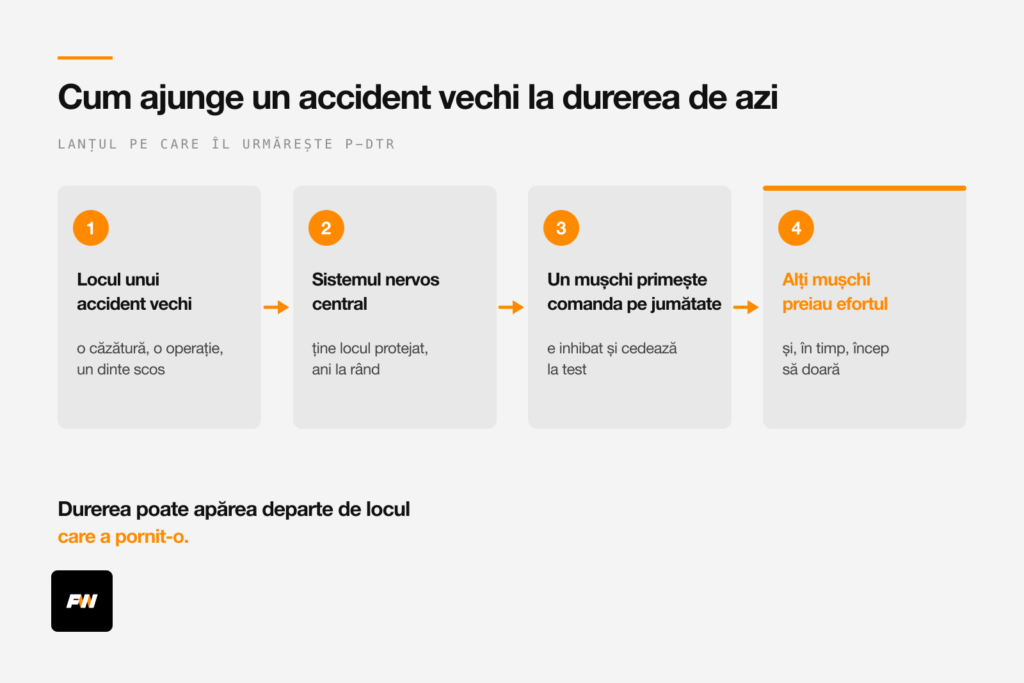
P-DTR starts from a simple observation: after an accident, the body remembers the place that got hurt and wants to protect it, so the nervous system changes the way it uses the muscles. Some no longer get the full command, and others do their job on top of their own.
The nervous system uses muscles like tools and decides which one works, which one rests and which one stays tense. On impact, the body pulls away through a withdrawal reflex, the same one that pulls your hand off a hot stove before you think. This reflex is well described in pain research: a painful stimulus starts the withdrawal movement on its own.
Here's my chin example. Someone comes in with back pain. At age 10 they fell off a bike, with a split chin and a tooth knocked out. I test a big muscle at the hip, and it's weak. I touch the chin, and the muscle contracts at full strength. Like a light switch.
Okay, but what does that mean?
It means that, for years, the body protected the chin and “switched off” the muscle that was supposed to hold the back. Meaning it kept it inhibited, with the command given only halfway, and other muscles took over its job until they started to hurt too. That's how links appear that seem to make no sense. Tudor, “generally a sceptical person”, as the review puts it, wrote: “The shoulder problem comes from some ankle sprains.” I explained this chain in the shoulder that won't lift anymore.
Why doesn't massage on the painful spot reach the cause?
Massage on the painful spot works on the muscle, but the decision to keep it tense or inhibited is made by the central nervous system. That's why the relief lasts a day or two, then the tension comes back.
When you go to the mechanic because a light came on in the dashboard, the mechanic checks the car. The mechanic doesn't change the dashboard bulb. The muscle is just a light bulb. Full stop.
Pain research describes the same thing. A theory published in the journal Pain, later developed in a paper on pain and motor control, shows that in pain the nervous system shifts the effort between muscles and inside them, to protect the area. In the moment it helps. In the long run it puts more load on other places and reduces movement.
The mistake is to massage the same spot for years. On an inhibited muscle, massage and the massage gun can even do harm. As long as the old place stays protected, the muscles that take over get tired and start to hurt, and the pain comes back after every massage. That place has to be treated. There is a solution for this, and that's where I help you.
What happens in a P-DTR session?
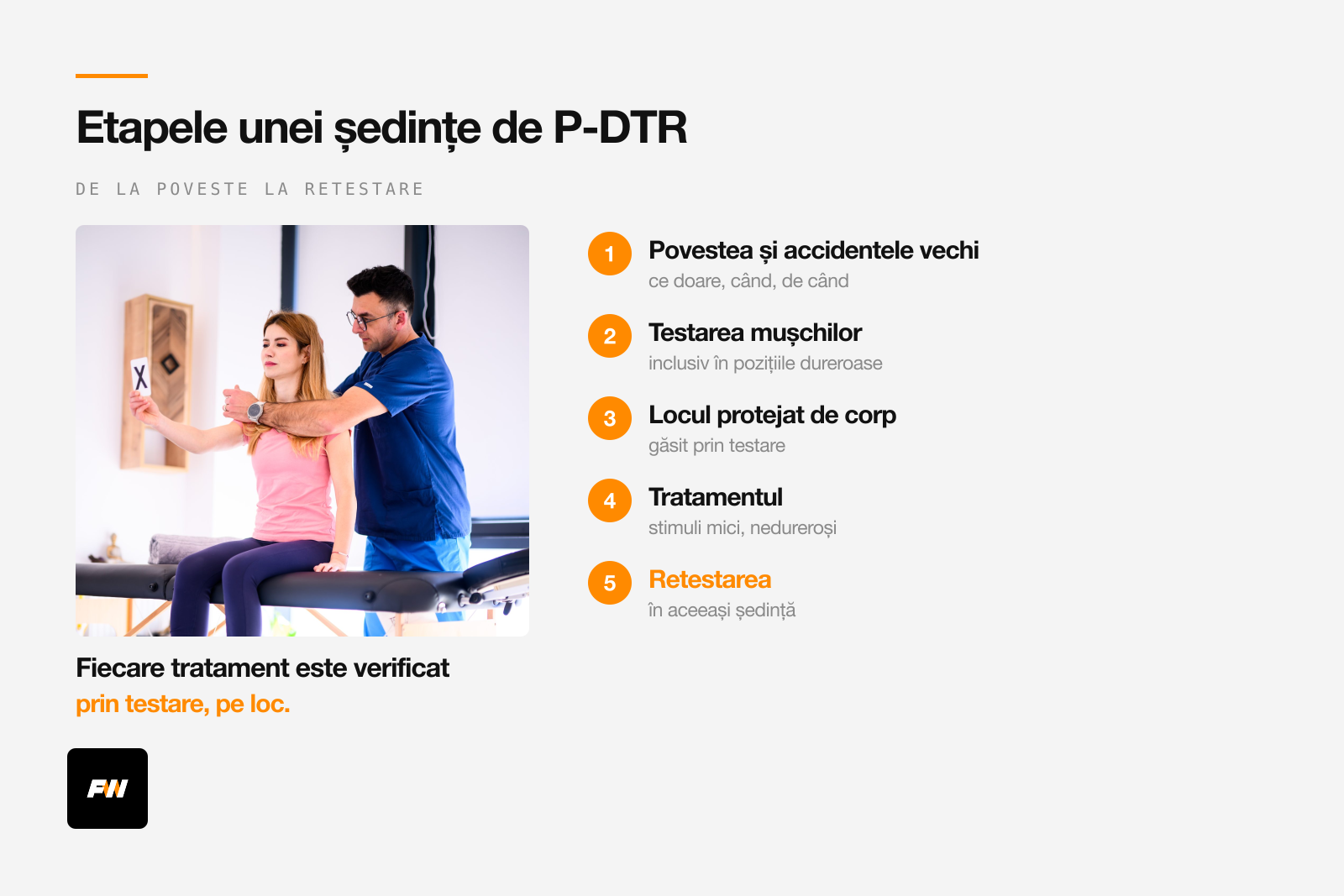
In a P-DTR session, I first listen to your story, then I test the muscles, look for the place the body is protecting, treat it and retest on the spot. Everything happens on the therapy table, and you see every test.
The wrong assumption is that people with the same pain get the same session. As a patient, I got the same protocol as five other people with herniations in different places, and that's where my obsession started. In P-DTR there's no conveyor-belt protocol. First we test, then we work. I test. I do NOT guess.
What do I ask you before I test you?
Before I test you, I ask what hurts, when it hurts and since when, then what other pain and accidents you've had over your life. The last question brings the gold, because that's where the places the body is still protecting show up. The questions always come in this order:
- What hurts.
- When it hurts: in the morning, when running, when bending over, after a day at the office.
- Since when it has been bothering you.
- What happened to you and roughly when.
- What else bothers you.
- What other pain you've had over your life, chronic or acute.
The first questions tell me what to test, and the last one tells me where to look. A fall from a tree at eight, a tooth pulled, an operation or a sprain “that went away on its own” all go on the list, even if they seem to have nothing to do with the pain you have now.
Why, when you sit in the dentist's chair, do you push yourself back into the seat and want to get out of there? The anaesthetic cuts the pain. But the body still feels something is happening to it there and wants to get away, and that place can stay on its list for years.
What does a muscle test look like?
A muscle test looks like this: I put you in a position, I ask you to hold your arm or leg in place, and I press lightly in the opposite direction. The muscle either holds, gives way, or is already tense. I also test in the positions where it hurts for you.
Sometimes the muscle looks strong, but after two or three seconds of holding it gives way. That tells me something else is compensating for it, for a short time. What I find in the test tells me what comes next:
| What I find in the test | What it means | What I do |
|---|---|---|
| Weak muscle | it's inhibited, meaning it doesn't get the full command | I look for the place keeping it that way and treat it |
| Normal muscle | it works the way it should | I leave it alone |
| Tense muscle | the nervous system holds it too tight, to help somewhere else | I relax it and look for why it's tightening |
The table explains why the same exercise helps one person and gets in the way for another. Advice given without a test, like “strengthen your back”, only hits the target by chance, because it doesn't know which row of the table you're in. That's why I retest on the spot, after each treatment, the muscle that was giving way.
A muscle switched off by the nervous system can switch back on quickly when the signal changes. In a study of 300 people with a torn cruciate ligament, 170 had the muscle at the front of the thigh blocked, and in almost eight out of ten the block gave way in the same consultation, with simple exercises. The study was done on knees, without P-DTR, and it shows the muscle was intact, it just wasn't getting the command. I wrote more about this in leg atrophy after an ACL tear.
What do you feel during the session?
During the session you feel light touches and small presses, and the strength tests are done with my hand, without weights. P-DTR is a painless therapy.
The surprising part is something else. You see with your own eyes how a muscle that was giving way holds after I've worked on a spot somewhere else in the body. Maria, who came in with a lumbar disc herniation, wrote after therapy: “I was really amazed to see where the pain had started: an ingrown toenail operation on my foot, back in childhood!”
That's why some people call it magic. They've never seen anything like it and don't understand what the therapist is doing. The mechanism is the one above: the body no longer has a reason to protect the treated place, and the nervous system gives the muscle the full command again. I explain it on the spot, at every test, so nothing stays “magic”.
Why I work P-DTR in a programme, alongside kinetotherapy
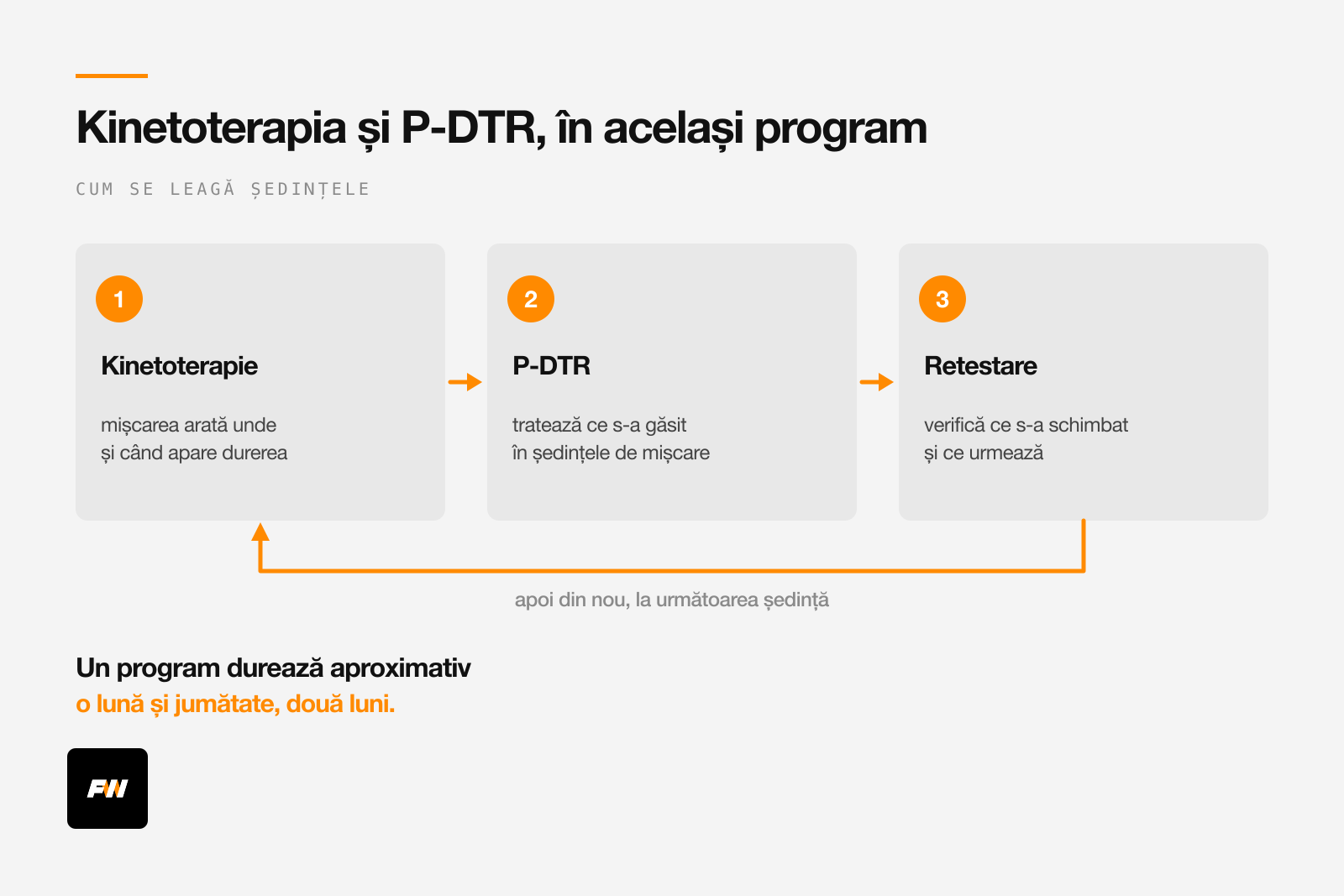
I work P-DTR in a programme, alongside kinetotherapy, because the kinetotherapy sessions show me what to treat at the next therapy session. Therapy without kinetotherapy is therapy by guesswork.
A programme lasts about a month and a half to two months, and it has P-DTR therapy sessions and kinetotherapy sessions, depending on how complicated the situation is. The mistake is to think one therapy session sees everything. On the table I see what I find that day, while your movements at home, how you bend or how you get out of bed, only come to the surface in the following weeks. And the studies on the switched-off muscle put movement first: a review from December 2024, of 20 studies on the muscle shutting down after a ligament tear, recommends structured exercise as the first choice, with the other methods alongside it.
What do I learn from the kinetotherapy sessions?
From the kinetotherapy sessions I learn where it hurts, when it hurts and which movement doesn't work, because I see you moving under load and in your everyday positions. I write everything down, and at the next therapy session I treat exactly what I found there.
For example, in a squat it bothers you only at one point on the way down, and lower down it doesn't hurt anymore. That small piece of the movement tells me exactly which muscle is working at that point, so where to look in therapy. Lying on the table, there's no way you can do the squat.
We don't do the first therapy sessions today and tomorrow, but with a break between them. In between, you write down the movement that bothers you at home and bring it to the session. Kinetotherapy without therapy treats the dashboard bulb. Together, each one feeds the other.
How long until you see a change?
The change in the test shows on the spot, in the same session, and a full programme lasts about a month and a half to two months. How long it takes and how many therapy sessions you need depends on how many places your body is protecting and how old the problem is. I won't give you a fixed timeframe.
Healing doesn't go in a straight line. The pain goes down, then up a little, then down again. One day can be worse than before, and the next day it's as if nothing happened. At around two months we retest, so you see the progress and I know what to change.
Lab studies show the other side too. In an analysis of 29 studies, from 2024, researchers caused a short pain in the neck, shoulder or jaw, and certain muscles received less command, depending on where the pain was. The pain came from an injection, and when it passed, the changes disappeared. When I test, I find places the body still protects years later. That's my observation from the clinic, and the study didn't measure it.
When we don't start with P-DTR
We don't start with P-DTR for brain and spinal cord injuries, rheumatic conditions in the acute phase of the inflammation, psychiatric disorders, acute inflammatory pain from the internal organs and congenital diseases. And we don't start with P-DTR when the pain has signs that need a doctor first.
These signs come from the NHS guidance on back pain, the UK's public health service:
- pain, tingling, weakness or numbness in both legs;
- loss of feeling around the genitals or the anus;
- changes when you pee or poo, for example you can't pee or you can't control it anymore;
- chest pain;
- the pain started after a serious accident, for example a car crash;
- fever, chills, or a strong pain that came on suddenly and gets worse fast.
If you have any of them, go to a doctor or to A&E first, and for chest pain call 112. Therapy comes after the doctor has ruled out an urgent problem. Therapy can wait a few days. These signs can't.
Where you start
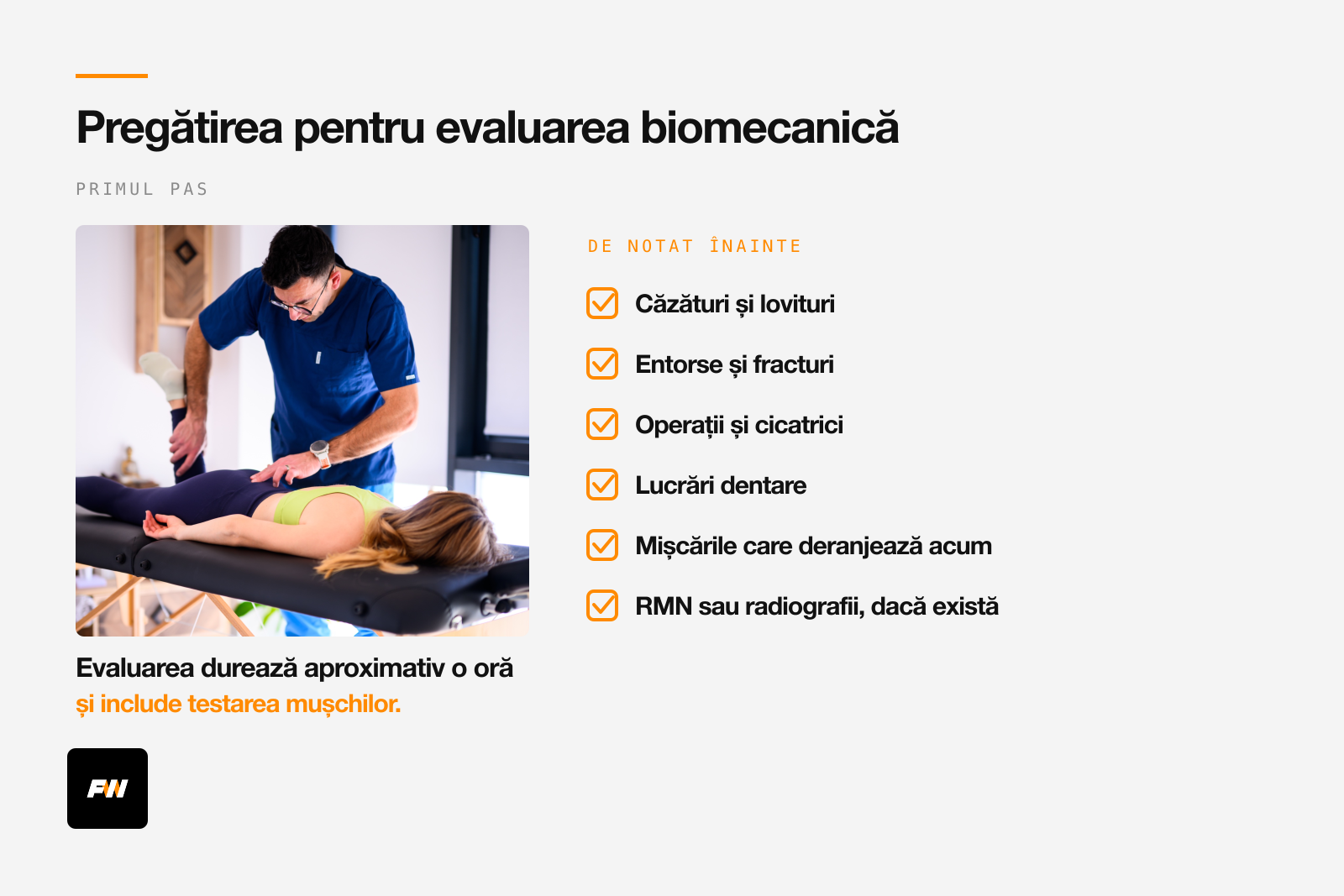
You start with the biomechanical assessment, which takes about an hour and costs 200 RON. There I listen to your story, test you, and we find out where your pain starts, then we choose the plan together. I guide you and suggest options, and you choose.
Nothing gets decided over a message. On WhatsApp there's no way I can test a muscle, and without a test any answer would be a guess. The programmes, with what each one includes, are on the P-DTR in Cluj page.
What to prepare for the biomechanical assessment
For the biomechanical assessment, prepare the list of accidents and pain in your life and, if you have them, your MRI or X-rays. The MRI isn't mandatory, and the list is the part that helps me most. What goes on the list, however old:
- falls, off a bike, from a tree, on ice, down the stairs;
- sprains, fractures and blows to the head;
- operations and scars, including small ones;
- dental work: extractions, implants, braces;
- the movements that bother you now and the time of day when it hurts;
- your MRI or X-rays, if you already have them.
Write the list at home, in peace, the day before, and put the year next to each accident, roughly. On the table, some people remember things forgotten for decades, but with the list in hand we don't lose time searching.
Frequently asked questions
Does P-DTR hurt?
P-DTR is a therapy that doesn't hurt. It uses small stimuli, a touch or a light press on the place I find, and the strength tests are done by hand, without weights. In the days after, the pain can go down, then up a little, then down again, because healing doesn't go in a straight line. You tell me what you felt at the next appointment.
Can I do P-DTR if I have a disc herniation?
You can, on one condition: the assessment comes first. For a herniation with a major motor deficit, meaning muscles that have lost a lot of their strength, I only work in the Extended Programme, with P-DTR and kinetotherapy. If you have the signs from “When we don't start with P-DTR”, go to a doctor first. Everything about herniation is on the disc herniation programme page.
How much does P-DTR cost in Cluj?
One P-DTR therapy session costs 600 RON, three sessions 1.700 RON, and five sessions 2.800 RON. Before that comes the biomechanical assessment, at 200 RON. I mostly work in programmes, with P-DTR and kinetotherapy: the Essential Programme costs 3.000 RON, the Extended Programme 4.500 RON, and Intensive Recovery 8.100 RON. It's all on the P-DTR page.
Is P-DTR the same thing as kinetotherapy?
P-DTR and kinetotherapy are two different things, which work together in my practice. Kinetotherapy means movement and exercises, chosen after the test, with the right intensity (weights) for you. P-DTR is the neurological therapy, done on the table, that looks for the place the body is protecting. Kinetotherapy shows me what to treat, and P-DTR changes the command going to the muscle.
Tonight, write down on a sheet of paper all the accidents you remember, from your first fall off a bike to the last tooth pulled, with the year next to each one. It's the best thing you can bring to the assessment.
Now you know what P-DTR is: a therapy that works on what's left after an accident, meaning on the way the body uses the muscles. The scar stays, the pulled tooth stays pulled. What changes shows in the test, before you leave the clinic.
You book the assessment from the contact page. Every body has a story. Let's see what yours has to tell us. What accident did you forget long ago?